
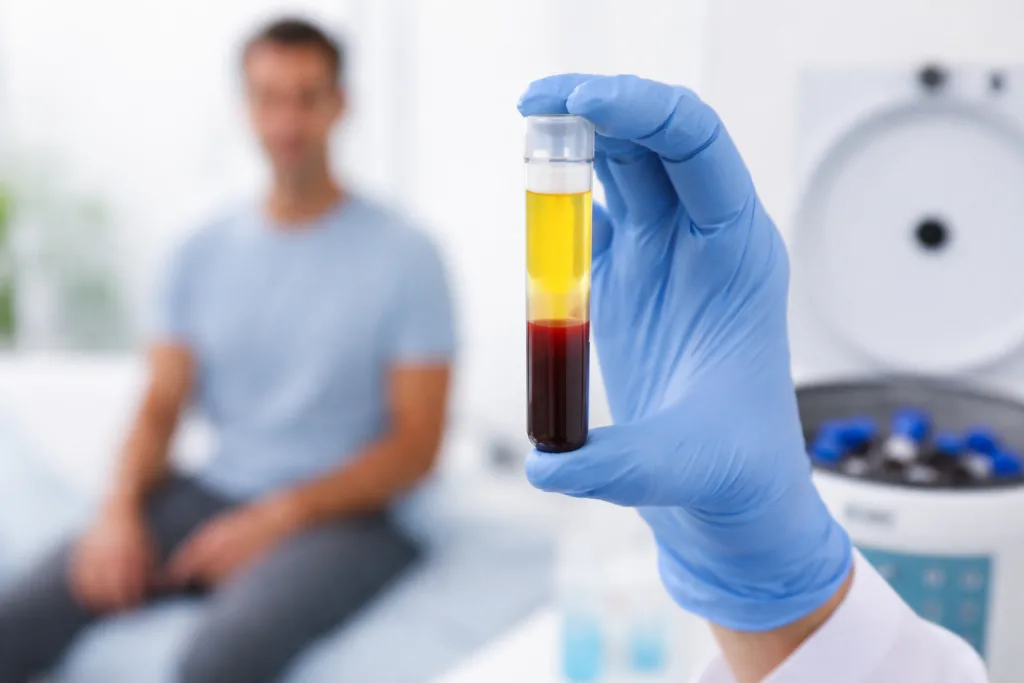




Platelet-rich plasma (PRP) is an autologous regenerative therapy derived from a patient’s own blood. Through a centrifugation process, platelets are concentrated to levels typically three to five times baseline, producing a biologic injectate rich in growth factors and cytokines that support tissue repair, modulate inflammation, and promote healing.
At Intercoastal Health, PRP is offered as part of our Regenerative Medicine program in Jacksonville, Florida, following careful patient selection, evidence-based indications, and medical oversight. PRP is not positioned as a universal solution, but as a targeted option for specific musculoskeletal and soft-tissue conditions where clinical data suggests potential benefit.
PRP is created by drawing a small volume of the patient’s blood and processing it to isolate the platelet-rich fraction.
Platelets contain alpha granules that release signaling molecules involved in angiogenesis, collagen synthesis, immune modulation, and tissue remodeling.
Once prepared, PRP is injected into a precisely identified tissue target—such as a joint, tendon, or surgical site—based on clinical examination,
imaging when appropriate, and functional assessment. Because PRP is autologous, it carries a low risk of allergic reaction or immune rejection.
Platelet-rich plasma (PRP) is an autologous regenerative therapy created from your own blood. It concentrates platelets to deliver growth factors that support tissue repair and inflammation modulation.
PRP at Intercoastal Health is performed under medical supervision following a comprehensive evaluation to ensure appropriate candidacy and precise targeting.
PRP is designed to support the body’s natural healing processes rather than temporarily masking pain.
Mild to moderate knee osteoarthritis (KL grades I–III)
PRP shows improved pain relief and function compared to corticosteroid and hyaluronic acid injections in multiple studies, particularly when delivered as a series of injections rather than a single treatment.
PRP may be appropriate in select cases, depending on diagnosis and clinical context, including:
Tennis elbow (lateral epicondylitis)
Rotator cuff tears (as surgical augmentation)
Certain acute musculoskeletal injuries
Select chronic wounds and dental applications
For some conditions, PRP has not consistently outperformed placebo or other therapies, including:
Rotator cuff tendinopathy (standalone injection)
Advanced knee osteoarthritis
We review these limitations openly and recommend alternatives when evidence is not supportive.
Activated platelets release growth factors such as VEGF, PDGF, and TGF-β, most of which are released shortly after activation. These signals support angiogenesis, extracellular matrix production, and tissue repair at the cellular level.
PRP may help reduce excessive pro-inflammatory signaling while promoting a shift toward anti-inflammatory macrophage activity. This regulatory effect can support more favorable healing conditions in chronically irritated or injured tissues.
Platelet adhesion molecules aid hemostasis and recruit fibroblasts and other repair cells. This process supports collagen synthesis, vascular remodeling, and progressive tissue strengthening rather than immediate symptomatic relief.
Clinical studies most consistently support PRP for mild to moderate knee osteoarthritis, particularly when delivered as a series of injections rather than a single treatment.
For certain tendinopathies and advanced joint disease, PRP has not consistently demonstrated superiority over placebo or alternative injection therapies.
Evidence varies significantly based on diagnosis, disease severity, PRP formulation, and injection technique—making individualized assessment essential.
We clearly explain where PRP is well-supported, where uncertainty exists, and when alternative treatments may be more appropriate.
What to Know Before PRP Treatment Platelet-rich plasma (PRP) is generally well tolerated when performed under appropriate medical oversight. Because PRP is derived from your own blood, serious complications are uncommon; however, it remains an injection-based procedure and requires careful patient selection.
PRP is considered low risk, but possible side effects include:
Temporary post-injection soreness or stiffness
Localized swelling or bruising
Pain flare during the early healing phase
Infection (rare, but possible with any injection)
Bleeding or hematoma formation, particularly in patients on blood-thinning medications
Most reactions are mild and self-limited. We review post-procedure expectations and activity guidance in advance.
PRP may be postponed or avoided in certain situations, including:
Active local or systemic infection
Severe thrombocytopenia or bleeding disorders
Active malignancy at the injection site
Recent use of antiplatelet or anticoagulant medications that cannot be safely held
Clinical scenarios where evidence does not support PRP for the condition being treated
At Intercoastal Health, a full medical history and medication review are completed prior to treatment to ensure safety and appropriateness.
Our approach to regenerative medicine prioritizes clinical judgment, evidence-based decision-making, and patient education
—ensuring each treatment plan is appropriate, transparent, and individualized.
Focused on musculoskeletal and regenerative decision-making, not one-size-fits-all injection protocols.
Treatment planning is guided by peer-reviewed research, professional guidelines, and condition-specific evidence.
Every plan is tailored to your diagnosis, functional goals, and clinical context—never a templated approach.
Clear expectations, honest discussions, and informed consent are central to every care decision.
Medical Disclaimer: Educational content only; treatment decisions are individualized.
PRP (platelet-rich plasma) is prepared using your own blood. A small blood sample is drawn—similar to routine lab work—then processed in a centrifuge to concentrate platelets. The platelet-rich portion is injected into the targeted tissue using a condition-specific technique.
The entire visit typically takes 30–60 minutes and is performed in an outpatient setting.
PRP is commonly administered as a series rather than a single injection.
Most evidence-supported protocols involve one to three injections, spaced several weeks apart. The recommended number depends on the condition treated, symptom severity, and individual response.
PRP does not provide immediate pain relief like anesthetics or corticosteroids.
While growth factors are released rapidly after injection, tissue healing occurs gradually. Most patients begin noticing improvement over several weeks, with continued progress over 2–3 months.
Effectiveness depends on the diagnosis.
Strongest evidence: Mild to moderate knee osteoarthritis and lateral epicondylitis (tennis elbow)
Mixed or limited evidence: Achilles tendinopathy, patellar tendinopathy, and certain rotator cuff conditions when used as standalone injections
At Intercoastal Health, candidacy is reviewed carefully, and alternatives are recommended when PRP is unlikely to provide benefit.
For knee osteoarthritis, PRP has demonstrated superior pain relief and functional improvement compared to corticosteroid injections at 3, 6, and 12 months in multiple studies.
However, PRP formulations and protocols vary, and results are condition-specific, so this comparison does not apply universally.
PRP has an excellent safety profile. Because it uses your own blood, risks of allergic reaction or disease transmission are extremely low.
Reported side effects are typically mild and may include temporary soreness, swelling, or stiffness at the injection site.
Most patients describe the injection as tolerable. Some discomfort during and after the procedure is expected, particularly in the first few days, but symptoms are usually short-lived and managed with activity modification.
PRP is generally considered an elective or investigational treatment and is not covered by most insurance plans, including Medicare and Medicaid.
PRP is typically an out-of-pocket expense, and costs are reviewed in advance.
Certain medications—especially antiplatelet agents such as aspirin or clopidogrel—may interfere with platelet function and PRP effectiveness.
Medication management is reviewed prior to treatment, and specific instructions are provided when adjustments are needed.
Post-treatment guidelines vary by condition, but typically include:
Temporary activity modification
Avoidance of anti-inflammatory medications for a specified period
Gradual return to exercise or sport
Rehabilitation or physical therapy when appropriate
Clear aftercare instructions are provided to support healing and optimize outcomes.
Yes. Intercoastal Health provides PRP therapy at our Jacksonville, Florida location. We serve patients throughout Jacksonville and the surrounding Northeast Florida area seeking evidence-informed regenerative medicine options.
PRP treatments at Intercoastal Health are performed under medical supervision by a licensed clinician with experience in musculoskeletal evaluation and regenerative medicine. All treatment plans are based on clinical assessment and current medical evidence.
No referral is required. Patients may schedule a regenerative medicine evaluation directly. During your visit, we determine whether PRP is appropriate or if another treatment option may be a better fit.
No. PRP preparation methods, platelet concentration, and injection techniques vary significantly between clinics. At Intercoastal Health, PRP protocols are selected based on diagnosis, evidence, and patient-specific factors—not a one-size-fits-all approach.
Appointment availability varies, but most patients can be scheduled within a reasonable timeframe. PRP preparation and injection are performed during an outpatient visit once candidacy is confirmed.
Yes. PRP is commonly considered for active adults and athletes with certain joint or tendon conditions when conservative treatments have not provided sufficient relief. Treatment plans are tailored to activity level and recovery goals.
In some cases, PRP may be incorporated into a broader regenerative or rehabilitation plan. Whether combination therapy is appropriate depends on diagnosis, goals, and available evidence and is discussed during your evaluation.
Intercoastal Health emphasizes evidence-informed care, individualized treatment planning, and transparency. We openly discuss where PRP is supported by research—and where limitations exist—so patients can make informed decisions.
This page summarizes current evidence and does not replace individualized medical advice. Treatment recommendations at Intercoastal Health are based on clinical evaluation, patient history, and appropriate risk–benefit discussion.
If you’re considering platelet-rich plasma (PRP) therapy, the first step is a comprehensive regenerative medicine evaluation to assess your symptoms, musculoskeletal findings, prior imaging (when available), and overall clinical context to determine whether PRP is an appropriate option.
Individualized care • Clinician-led • Evidence-informed treatment
At Intercoastal Health, our regenerative medicine clinic in Jacksonville, Florida provides an evidence-informed, patient-centered approach to platelet-rich plasma (PRP) therapy and non-surgical musculoskeletal care. Serving patients throughout Jacksonville and Northeast Florida, we emphasize comprehensive clinical evaluations, detailed functional and biomechanical assessment, and individualized treatment planning grounded in current medical literature.
PRP therapy at Intercoastal Health is delivered under medical oversight with a strong focus on appropriate patient selection, transparency, and education. We take time to explain where PRP is supported by evidence, where outcomes may be variable, and how PRP fits within a broader regenerative and rehabilitative strategy—rather than offering one-size-fits-all injection protocols.
In addition to PRP, Intercoastal Health offers a full spectrum of advanced medical services, including regenerative medicine, hormone replacement therapy, longevity medicine, peptide therapy, and injury-focused medical care. Through this integrated, clinician-guided framework, we support informed decision-making and personalized care for patients seeking advanced treatment options such prolotherapy, PRP, exosomes, or stem cell therapy in the Jacksonville, FL area.
In addition to platelet-rich-plasma injections, Intercoastal Health offers a full spectrum of advanced medical services, including regenerative medicine, hormone replacement therapy, longevity medicine, and peptide therapy medical care. Through this integrated approach, we support informed decision-making and personalized care for patients seeking advanced, clinician-guided treatment options in the Jacksonville, FL area.
Business Hours
Monday: 9AM – 6PM
Tuesday: 9AM – 6PM
Wednesday: 9AM – 6PM
Thursday: 9AM – 6PM
Friday: 9AM – 6PM
Saturday: Closed
Sunday: Closed
Comprehensive care with a whole person approach, specializing in injury management, wellness, and longevity.
3874 San Jose Park Drive
Suite 5
Jacksonville, Florida 32217
Disclaimer: The content on this website is for informational purposes only and does not constitute medical advice or replace professional medical care, diagnosis, or treatment. Eligibility for medical treatments will be determined by your healthcare provider, who will exercise discretion regarding your treatment plan. All images are intended for educational purposes only. Statements made on this website have not been evaluated by the Food and Drug Administration. Always consult your healthcare provider before initiating or discontinuing any treatment.
Intercoastal Health – Copyright © 2026 All Rights Reserved - Privacy Policy