HOMA2-%B (Beta-Cell Function) Biomarker

Your Insulin-Producing Cells: Are They Working Optimally?

Authored by Chris McDermott, APRN — Practicing with autonomous authority in Florida

HOMA2-%B (Homeostasis Model Assessment of Beta-Cell Function) is a calculated biomarker that estimates how effectively your pancreatic beta cells produce and secrete insulin. Derived from fasting glucose and insulin measurements, this assessment provides valuable insight into your metabolic health trajectory—often detecting beta-cell dysfunction years before diabetes develops. Understanding your HOMA2-%B can help guide personalized interventions to preserve insulin-producing capacity and prevent metabolic decline. Learn about our lab guided approach to functional medicine.

HOMA2-%B (Beta-Cell Function) Biomarker

Understanding HOMA2-%B Biomarker?

🧬 What Is HOMA2-%B ?

HOMA2-%B is a computer-modeled calculation that estimates pancreatic beta-cell function from fasting blood glucose and insulin (or C-peptide) concentrations. Unlike the original HOMA1 formula from 1985, HOMA2 uses a more sophisticated algorithm that accounts for both hepatic glucose output and peripheral glucose uptake, providing a more accurate assessment of beta-cell secretory capacity.

Key Concepts to Understand About HOMA2-%B

A “snapshot” of fasting beta-cell output, not maximal reserve

HOMA2-%B reflects steady-state physiology at fasting. It does not measure peak insulin secretion capacity (e.g., during an OGTT), so it’s most useful for trends and pattern recognition when combined with other data.

Early insulin resistance often shows “high %B” (compensation)

In early insulin resistance, beta cells may increase secretion to maintain glucose—so HOMA2-%B can rise while HOMA2-IR also rises. This can signal compensatory hyperinsulinemia before overt hyperglycemia.

Falling %B with rising IR can signal progression risk

If insulin resistance is increasing (higher HOMA2-IR) while HOMA2-%B trends down, the pattern can suggest beta-cell strain/dysfunction and rising progression risk toward prediabetes/T2D—especially when supported by A1C, fasting glucose, or post-prandial markers.

📊 Standard Reference Ranges for HOMA2-%B

Important note: There is no single universal “normal” for HOMA2-%B across all populations because values vary by insulin assay, glucose method, demographics, and clinical context. The HOMA2 model is calibrated so that “normal” young adults approximate 100%.

Range card (commonly used clinical ranges)

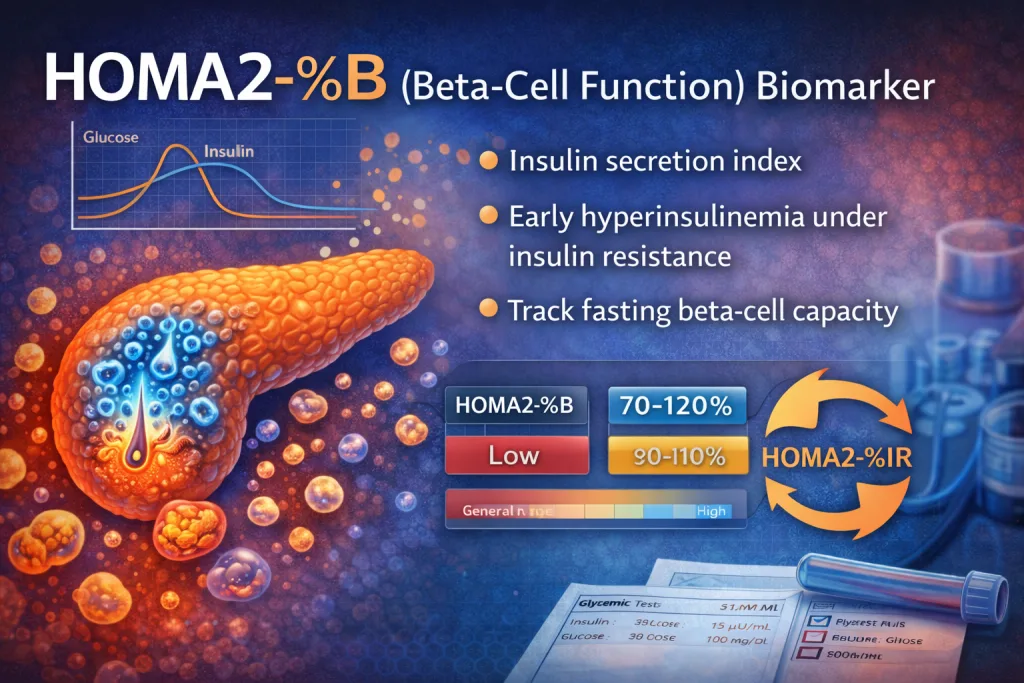
  • General “standard” range: 70–120%

  • Common “optimal target” used in some functional/clinical frameworks: 90–110%

Insulin Resistance & Beta-Cell Function Review

If your fasting glucose is “normal” but fasting insulin is elevated, schedule a functional medicine evaluation to interpret HOMA2-%B and HOMA2-IR patterns and build a targeted plan.

Individualized care • Medically supervised • Lab-guided treatment

⚠️ Abnormal HOMA2-%B Levels: Clinical Implications

Low HOMA2-%B (below range)

May reflect reduced fasting insulin secretion and can be seen with worsening dysglycemia, longstanding insulin resistance with beta-cell fatigue, or other pancreatic/endocrine factors. Interpretation should incorporate fasting glucose, A1C, C-peptide, and medications.

High HOMA2-%B (above range)

Commonly reflects compensatory hyperinsulinemia—beta cells working harder to keep fasting glucose controlled in the setting of insulin resistance. When paired with elevated HOMA2-IR, it can indicate early metabolic dysfunction even if glucose is “normal.”

🧪 Interfering Factors in HOMA2-%B Testing

Physiologic/Clinical Factors
or Assay Interference

  • Non-fasting state, recent high-carbohydrate intake, poor sleep, acute illness/inflammation, and stress physiology can shift fasting glucose/insulin and distort the estimate.

  • Reduced renal function can change insulin/C-peptide kinetics; C-peptide–based calculation may behave differently than insulin-based calculation.

  • Assay variation (insulin vs specific insulin vs C-peptide) affects comparability across labs and over time.

Medications Affecting Leptin Levels

  • Increase apparent %B (often by increasing insulin output or improving glycemia): sulfonylureas/meglitinides; sometimes GLP-1 therapies via improved glycemic environment (interpretation depends on timing and mechanism).

  • Lower insulin levels / alter secretion or sensitivity: corticosteroids (raise glucose and can worsen resistance), thiazides, some beta-blockers (variable), and exogenous insulin can complicate interpretation depending on whether insulin or C-peptide is used.

    (Clinical correlation required—trend interpretation is often more meaningful than a single value.)

🔍 Related & Complementary Testing

HOMA2-%B assessment is most informative when evaluated alongside:

  • Fasting C-peptide (paired with fasting glucose)
    HOMA2 can be calculated using C-peptide instead of insulin, and C-peptide can be especially helpful when exogenous insulin use or insulin clearance confounds fasting insulin interpretation.

🩺 When to Test HOMA2-%B

Consider HOMA2-%B when you want to:

  • Evaluate early metabolic compensation (high insulin with normal glucose)
  • Track beta-cell trajectory during lifestyle change, weight loss, or metabolic therapy (trend over time)
  • Risk-stratify when fasting markers suggest insulin resistance but the clinical picture is unclear

Use standardized prep: 8–12 hour fast, stable routine for 48–72 hours, avoid testing during acute illness when possible.

🧠 Clinical Interpretation Considerations

HOMA2-%B should be interpreted alongside:

  • HOMA2-IR (or HOMA2-%S) to distinguish compensation vs decline

  • A1C, fasting glucose, (optionally) OGTT, triglycerides/HDL, ALT, and clinical phenotype

  • Medication context (agents that alter insulin secretion or glucose)

Best practice: interpret patterns (e.g., “IR up + %B up” vs “IR up + %B down”), not just single cutoffs.

✅ Clinical Summary

A comprehensive evaluation by a functional medicine Nurse Practitioner in Florida supports identification of cellular-level and molecular imbalances that contribute to insulin resistance and progressive beta-cell strain. By integrating evidence-based allopathic care with a functional integrative approach—including quantitative biomarker profiling, individualized nutrition and lifestyle interventions, and targeted therapeutics—this framework moves beyond symptom management to address upstream metabolic drivers. For patients who want a proactive, aging-focused strategy tied to metabolic resilience, explore Longevity Medicine. Contact us at 904-799-2531.

📚 Further Reading

1.Use and Abuse of HOMA Modeling.Diabetes Care. 2004. Wallace TM, Levy JC, Matthews DR.
2.Causal Associations in Type 2 Diabetes Development. The Journal of Clinical Endocrinology and Metabolism. 2019. Marott SCW, Nordestgaard BG, Tybjærg-Hansen A, Benn M.
5. Effect of Homeostasis Model Assessment Computational Method on the Definition and Associations of Insulin Resistance Clinical Chemistry and Laboratory Medicine. 2010. Mojiminiyi OA, Abdella NA.

Prediabetes Prevention & Metabolic Optimization Visit

A medically-guided approach to improving insulin sensitivity, reducing compensatory hyperinsulinemia, and protecting long-term beta-cell function with personalized nutrition, activity, sleep, stress, and lab-guided therapeutics. Schedule a functional medicine evaluation 

Personalized care • Clinician-directed • Data-driven treatment

Intercoastal Health

Business Hours
Monday: 9AM – 6PM
Tuesday: 9AM – 6PM
Wednesday: 9AM – 6PM
Thursday: 9AM – 6PM
Friday: 9AM – 6PM
Saturday: Closed
Sunday: Closed

Request an Appointment

Please do not include sensitive medical information.
Patient Consent & Acknowledgment