
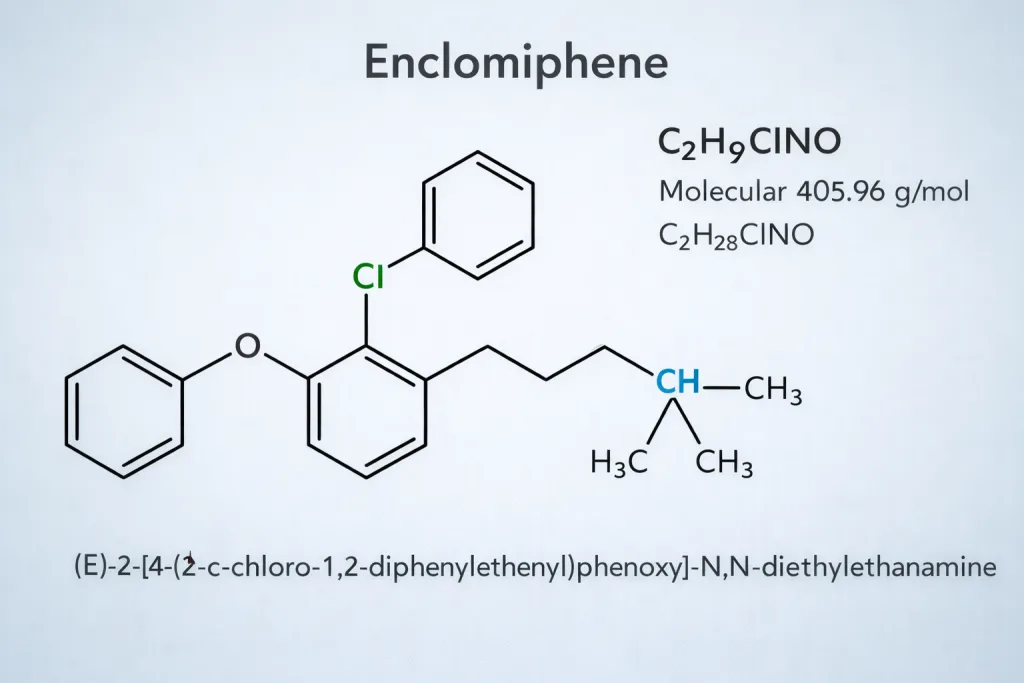
Enclomiphene citrate has gained increasing attention as a treatment option for select men with testosterone deficiency—particularly those who wish to improve hormone levels without compromising fertility. Unlike traditional testosterone replacement therapy (TRT), which supplies exogenous testosterone and suppresses the body’s natural hormone production, enclomiphene works by stimulating endogenous testosterone synthesis through the hypothalamic–pituitary–testicular (HPT) axis.
It is important to clarify from the outset that enclomiphene is not a peptide. Enclomiphene citrate is a nonsteroidal selective estrogen receptor modulator (SERM) and the trans-isomer of clomiphene citrate, a medication long used in reproductive medicine.
Enclomiphene citrate is a triphenylethylene derivative SERM, chemically related to agents such as tamoxifen and toremifene. It is a small organic molecule—not an amino-acid chain—and therefore does not meet the chemical definition of a peptide.
As a SERM, enclomiphene selectively antagonizes estrogen receptors in the hypothalamus and pituitary gland, reducing estrogen’s negative feedback on gonadotropin release. This results in increased secretion of:
These hormones stimulate testicular testosterone production while preserving spermatogenesis, distinguishing enclomiphene from TRT, which suppresses LH and FSH.
🔗 Foundational SERM mechanisms are detailed in The New England Journal of Medicine
Enclomiphene citrate is not FDA-approved for any indication, including male hypogonadism. Only clomiphene citrate (the racemic mixture of enclomiphene and zuclomiphene) holds FDA approval—and only for ovulatory dysfunction in women.
Use of enclomiphene or clomiphene citrate in men is therefore off-label, though supported by multiple randomized controlled trials and acknowledged in professional society guidance for fertility-preserving care. Considering Enclomiphene as alternative to traditional testosterone replacement therapy.
Multiple Phase II and III clinical trials demonstrate that enclomiphene citrate consistently restores testosterone into the normal range (approximately 500–600 ng/dL) while maintaining or improving sperm counts in men with secondary hypogonadism.
Phase III trials (ZA-304 and ZA-305) showed that enclomiphene 12.5 mg and 25 mg daily significantly increased testosterone at 16 weeks while preserving normal sperm concentrations, unlike testosterone gel
🔗 BJU International (2016)
A Phase II study demonstrated testosterone increases from a baseline mean of 165 ng/dL to 525 ng/dL at 6 months, with sperm concentrations ranging from 75–334 × 10⁶/mL
🔗 The Journal of Sexual Medicine (2013)
Pharmacokinetic studies confirmed testosterone normalization within 2 weeks, with LH and FSH rising above baseline—opposite the suppressive effects seen with TRT
🔗 BJU International (2013)
Enclomiphene citrate is best suited for:
Men with secondary hypogonadism
Men with low testosterone and low or inappropriately normal LH
Men who wish to preserve fertility
Overweight or obese men with functional hypogonadism
Men seeking an alternative to TRT due to fertility, testicular atrophy, or long-term dependency concerns
It is not appropriate for men with primary hypogonadism (testicular failure) or those requiring immediate fertility induction, where gonadotropin therapy is more appropriate.
Professional guidance from the American Urological Association (AUA) and American Society for Reproductive Medicine (ASRM) supports the off-label use of SERMs for infertile men with low testosterone who desire fertility preservation.
Enclomiphene citrate is taken orally, typically once daily. While clinical studies have used doses ranging from 12.5–25 mg daily, there is no FDA-approved dosing regimen, as enclomiphene is not FDA-approved for male hypogonadism. Therapy should always be individualized and medically supervised.
Routine monitoring commonly includes:
LH and FSH
Semen analysis when fertility is a goal
Follow-up is commonly performed at 4–6 weeks, then every 3 months thereafter.
Short- to medium-term clinical trials indicate that enclomiphene citrate is generally well tolerated, with mild side effects such as headache or gastrointestinal discomfort reported infrequently.
One consideration with long-term clomiphene citrate use is the preferential accumulation of zuclomiphene, which has a longer half-life. Whether pure enclomiphene avoids this accumulation remains an area of ongoing research.
| Feature | Enclomiphene Citrate | TRT |
|---|---|---|
| Testosterone source | Endogenous production | Exogenous |
| LH / FSH | Increased | Suppressed |
| Fertility | Preserved | Often impaired |
| Testicular volume | Maintained | May decrease |
| FDA-approved for men | ❌ No | ✅ Yes |
While no major endocrine society formally endorses enclomiphene for routine hypogonadism treatment, evidence supports its role in fertility-preserving testosterone restoration. For carefully selected men with secondary hypogonadism, enclomiphene offers a physiologic alternative to testosterone replacement.
A comprehensive hormone evaluation is essential before initiating therapy. Identifying the underlying cause of testosterone deficiency—including gonadotropin signaling, estradiol balance, and metabolic contributors—ensures appropriate treatment selection.
🔗 Learn more about medically guided enclomiphene therapy at Intercoastal Health:
🔗 Explore related hormone services:
A personalized, evidence-based approach allows for safe dosing, appropriate monitoring, and optimized long-term hormone health.
Enclomiphene citrate offers a fertility-preserving, physiology-based approach to testosterone optimization in appropriately selected men. By stimulating endogenous testosterone production rather than replacing it, enclomiphene provides a distinct alternative to traditional TRT.
While its use in men remains off-label, clinical evidence supports its effectiveness and safety when prescribed thoughtfully and monitored appropriately. Men considering enclomiphene therapy should do so under the guidance of an experienced medical provider to ensure optimal outcomes and long-term hormone health.
Intercoastal Health offers Testosterone Replacement Therapy (TRT) & Hormone Replacement Therapy in Jacksonville, FL. Additional Peptide Therapies that are help for recovery, repair, and optimization include BPC 157 Peptide, Pentadeca Arginate Peptide, & Sermorelin Peptide.
If you’re experiencing symptoms of low testosterone and want a non-injectable, fertility-preserving approach, the first step is a comprehensive medical evaluation.
Individualized care • Medically supervised • Lab-guided treatment


Considering initiating a Enclomiphene Therapy regimen in Jacksonville FL? We offer flexible appointment options, including telemedicine consultations. Our team is available to assist you in scheduling your consultation and ensuring that you receive the appropriate care tailored to your needs.
Business Hours
Monday: 9AM – 6PM
Tuesday: 9AM – 6PM
Wednesday: 9AM – 6PM
Thursday: 9AM – 6PM
Friday: 9AM – 6PM
Saturday: Closed
Sunday: Closed

Comprehensive care with a whole person approach, specializing in injury management, wellness, and longevity.
3874 San Jose Park Drive
Suite 5
Jacksonville, Florida 32217
Disclaimer: The content on this website is for informational purposes only and does not constitute medical advice or replace professional medical care, diagnosis, or treatment. Eligibility for medical treatments will be determined by your healthcare provider, who will exercise discretion regarding your treatment plan. All images are intended for educational purposes only. Statements made on this website have not been evaluated by the Food and Drug Administration. Always consult your healthcare provider before initiating or discontinuing any treatment.
Intercoastal Health – Copyright © 2026 All Rights Reserved - Privacy Policy