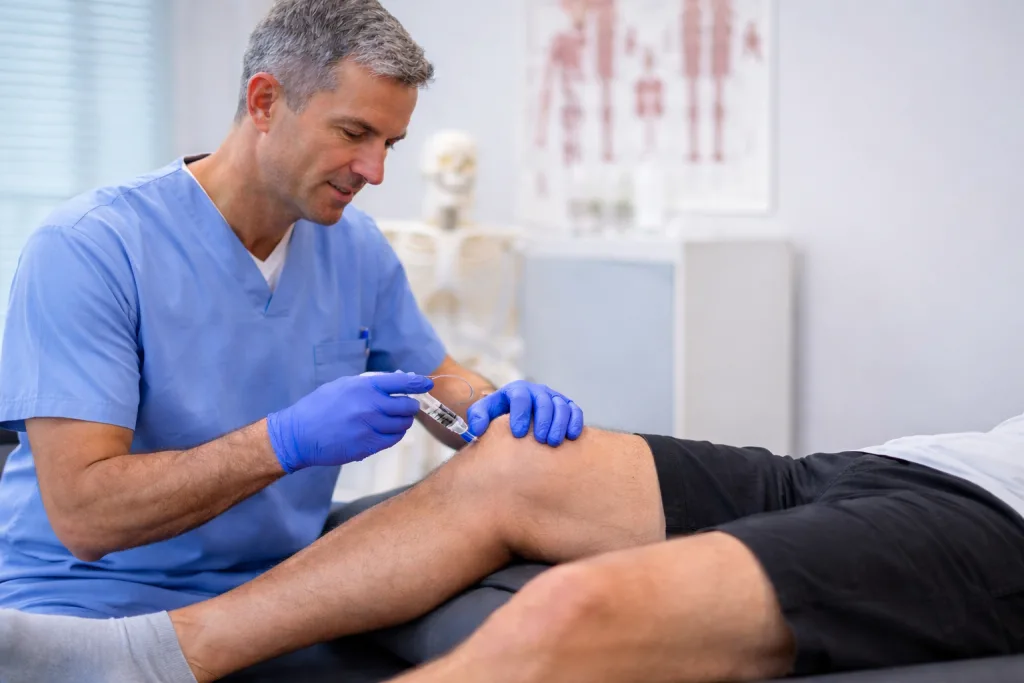
Prolotherapy is an injection-based regenerative treatment that uses an irritant solution—most commonly hypertonic dextrose (often ~12.5–25%)—to stimulate
a controlled healing response at painful tendon and ligament attachments and, in select cases, within joints.
The goal is to support tissue strengthening and pain reduction over a structured treatment series.
Prolotherapy (often referred to as dextrose prolotherapy when dextrose is used) is a non-surgical regenerative injection technique. Small volumes of solution are injected at precise anatomic targets—typically tendon insertions, ligaments, or periarticular structures—to provoke a localized inflammatory response that may promote growth factor signaling, collagen remodeling, and gradual tissue strengthening over time.
Injection sites are selected based on anatomy, physical examination findings, and identification of the most likely pain generator—not a one-size-fits-all approach.
Prolotherapy is typically delivered as a series of treatments (often three or more sessions), as regenerative responses tend to be time-dependent and cumulative.
Unlike steriod injections designed to temporarily reduce pain or inflammation, prolotherapy aims to stimulate a healing cascade that may strengthen tissue over time.
Prolotherapy is most often considered for individuals with chronic musculoskeletal pain who have not responded adequately to conservative care such as physical therapy, activity modification, bracing, or appropriate medication strategies. It may be appropriate when pain is thought to be driven by tendon or ligament attachment irritation, degenerative joint changes, or functional instability patterns.
The condition of Knee Osteoarthritis has the strongest overall evidence base for prolotherapy, with multiple studies showing improvements in pain and function.
Evidence supports meaningful pain reduction and functional improvement in many patients with tennis elbow, particularly in short- to mid-term follow-up.
Conditions such as plantar fasciitis, Achilles tendinopathy, and rotator cuff tendinopathy may benefit, though evidence is more variable and patient selection is critical.
The precise biological mechanism of prolotherapy is likely multifactorial and not fully elucidated. Current evidence suggests the injected solution creates a localized irritant effect that initiates an inflammatory signaling cascade, potentially leading to growth factor release, collagen deposition, and tissue remodeling over time.
Localized cellular irritation → modulation of inflammatory pathways → activation of wound-healing and repair processes.
Injections are delivered to specific anatomic structures such as tendon insertions, ligaments, or select intra-articular spaces, based on exam findings and clinical reasoning.
Many studies suggest outcomes may be dose-dependent and time-dependent, making a planned series—rather than a single injection—more consistent for appropriate candidates.
At Intercoastal Health, prolotherapy is typically integrated with rehabilitation, load management, and—when clinically appropriate—other regenerative strategies.
We practice evidence-informed regenerative care. Below is a patient-friendly summary of how prolotherapy performs across commonly studied conditions in the medical literature.
Meta-analyses demonstrate meaningful improvements in pain and function compared to placebo and exercise-only interventions, with some comparative trial data suggesting favorable outcomes versus other injection therapies.
Systematic reviews show clinically relevant pain reduction and functional improvement at short- to mid-term follow-up, often measured using validated outcome tools.
Evidence suggests potential benefit for Achilles tendinopathy, plantar fasciitis, and rotator cuff disease, though study size and protocols vary widely.
Evidence for Chronic Soft Tissue Injury is inconsistent, and higher-quality trials have not shown clear benefit. Prolotherapy is generally not recommended for this indication.
Research varies significantly in injection technique, solution concentration, co-interventions, and follow-up duration.
We discuss where evidence is strongest—and where uncertainty remains—during your evaluation.
Musculoskeletal-focused regenerative care with rehab integration
Anatomy-driven, diagnosis-specific decision-making
Peer-reviewed evidence with transparent discussion of limitations
Clear expectations, alternatives, and measurable goals
Medical Disclaimer: Educational content only; treatment decisions are individualized.
Prolotherapy is a regenerative injection therapy that involves injecting an irritant solution—most commonly hypertonic dextrose—into painful ligaments, tendons, or periarticular structures. The intent is to stimulate a controlled local inflammatory response that may promote tissue repair, collagen remodeling, and gradual strengthening of injured or degenerated tissue.
Prolotherapy is most commonly evaluated for chronic musculoskeletal conditions, particularly those involving ligament or tendon attachment pain or degenerative joint changes. The strongest evidence supports use in knee osteoarthritis and lateral epicondylosis (tennis elbow). Other conditions such as plantar fasciitis, Achilles tendinopathy, and select rotator cuff disorders may benefit in certain patients, though evidence is more limited and variable.
Yes—knee osteoarthritis has the most robust evidence base for prolotherapy among studied indications. Multiple systematic reviews and meta-analyses report significant improvements in pain and physical function compared with placebo and exercise-only interventions. Some studies suggest prolotherapy may provide comparable or favorable outcomes relative to other injection therapies. Patient selection, disease severity, and biomechanics play an important role in outcomes.
Prolotherapy is usually performed as a series of treatments, not a single injection. Many protocols involve three or more sessions, typically spaced several weeks apart. The number of sessions depends on the condition treated, symptom duration, tissue involved, and individual response. Because regenerative responses develop gradually, improvements are often seen over weeks to months rather than immediately.
Mild to moderate discomfort during and after the injection is common, particularly in the first few days following treatment. Post-injection soreness or stiffness is expected and typically temporary. Most patients tolerate the procedure well, and discomfort is managed with appropriate guidance on activity modification and recovery.
No. Prolotherapy and platelet-rich plasma (PRP) are both regenerative injection therapies, but they work through different biological mechanisms.
Prolotherapy most commonly uses a hypertonic dextrose solution to trigger a localized inflammatory and healing response.
PRP uses concentrated components from your own blood, including platelets and growth factors, to support tissue repair.
Which option is appropriate depends on the specific diagnosis, target tissue, available evidence, and individual patient factors. In some cases, one approach may be favored over the other; in others, neither may be indicated. We review these options during your regenerative medicine evaluation.
For chronic low back pain, the evidence is inconsistent, and the highest-quality randomized controlled trials have not demonstrated clear benefit. As a result, a major occupational and environmental medicine guideline recommends against prolotherapy for this indication.
At Intercoastal Health, we follow evidence-based practice. When low back pain is the primary concern, we typically prioritize other diagnostic and treatment strategies with stronger clinical support and explain the rationale for those recommendations during your visit.
When performed by a qualified clinician using appropriate sterile technique and patient selection, prolotherapy is generally considered low risk. Common side effects include temporary soreness, stiffness, bruising, or swelling at the injection site. More serious complications such as infection or nerve irritation are rare.
Prolotherapy may be deferred or modified in patients with active infection at the injection site, uncontrolled medical conditions that increase procedural risk, or clinical scenarios where evidence does not support its use. A comprehensive medical history review is performed before treatment.
Prolotherapy does not typically provide immediate relief. Because it relies on a regenerative process, improvements often occur gradually over weeks to months, particularly after multiple sessions. Progress is assessed through changes in pain, function, and activity tolerance over time.
Prolotherapy is commonly classified as an elective or investigational treatment by many insurance carriers and is therefore often not covered. Intercoastal Health does not participate with private health insurance, Medicare, or Medicaid. At this time, we accept automobile insurance only for eligible services.
The best way to determine candidacy is through a regenerative medicine evaluation that includes a focused history, physical examination, functional assessment, and review of imaging when available. Treatment recommendations are individualized and based on the best available medical evidence.
This page summarizes current evidence and does not replace individualized medical advice. Treatment recommendations at Intercoastal Health are based on clinical evaluation, patient history, and appropriate risk–benefit discussion.
Goh SL, Jaafar Z, Gan YN, et al. Efficacy of Prolotherapy in Comparison to Other Therapies for Chronic Soft Tissue Injuries: A Systematic Review and Network Meta-Analysis. PloS One. 2021;16(5):e0252204. PMID: 34038486
Distel LM, Best TM. Prolotherapy: A Clinical Review of Its Role in Treating Chronic Musculoskeletal Pain. PM & R. 2011;3(6 Suppl 1):S78-81. PMID: 21703585
Sit RW, Chung VCh, Reeves KD, et al. Hypertonic Dextrose Injections (Prolotherapy) in the Treatment of Symptomatic Knee Osteoarthritis: A Systematic Review and Meta-Analysis. Scientific Reports. 2016;6:25247. PMID: 27146849
Chung MW, Hsu CY, Chung WK, Lin YN. Effects of Dextrose Prolotherapy on Tendinopathy, Fasciopathy, and Ligament Injuries, Fact or Myth?: A Systematic Review and Meta-Analysis. Medicine. 2020;99(46):e23201. PMID: 33181700
Rabago D, Nourani B. Prolotherapy for Osteoarthritis and Tendinopathy: A Descriptive Review. Current Rheumatology Reports. 2017;19(6):34. PMID: 28484944
Hsu C, Vu K, Borg-Stein J. Prolotherapy: A Narrative Review of Mechanisms, Techniques, and Protocols, and Evidence for Common Musculoskeletal Conditions. Physical Medicine and Rehabilitation Clinics of North America. 2023;34(1):165-180. PMID: 36410881
Chen YW, Lin YN, Chen HC, et al. Effectiveness, Compliance, and Safety of Dextrose Prolotherapy for Knee Osteoarthritis: A Meta-Analysis and Metaregression of Randomized Controlled Trials. Clinical Rehabilitation. 2022;36(6):740-752. PMID: 35257594
Huang K, Cai H. Hypertonic Dextrose Prolotherapy in Osteoarthritis: Mechanisms, Efficacy, and Future Research Directions. Frontiers in Endocrinology. 2025;16:1602727. PMID: 40831953
Fong HPY, Zhu MT, Rabago DP, et al. Effectiveness of Hypertonic Dextrose Injection (Prolotherapy) in Plantar Fasciopathy: A Systematic Review and Meta-Analysis of Randomized Controlled Trials. Archives of Physical Medicine and Rehabilitation. 2023;104(11):1941-1953.e9. PMID: 37098357
Giordano L, Murrell WD, Maffulli N. Prolotherapy for Chronic Low Back Pain: A Review of Literature. British Medical Bulletin. 2021;138(1):96-111. PMID: 33884404
Reeves KD, Sit RW, Rabago DP. Dextrose Prolotherapy: A Narrative Review of Basic Science, Clinical Research, and Best Treatment Recommendations. Physical Medicine and Rehabilitation Clinics of North America. 2016;27(4):783-823. PMID: 27788902
Waluyo Y, Artika SR, Insani Nanda Wahyuni, Gunawan AMAK, Zainal ATF. Efficacy of Prolotherapy for Osteoarthritis: A Systematic Review. Journal of Rehabilitation Medicine. 2023;55:jrm00372. PMID: 36847731
If you’re considering prolotherapy, the first step is a comprehensive regenerative medicine evaluation to review your symptoms, musculoskeletal findings, and overall clinical context.
Individualized care • Clinician-led • Evidence-informed treatment
At Intercoastal Health, our regenerative medicine clinic in Jacksonville, Florida delivers an evidence-informed, patient-centered approach to prolotherapy and non-surgical musculoskeletal care. Serving patients throughout Jacksonville and Northeast Florida, we focus on comprehensive clinical evaluations, detailed functional and biomechanical assessment, and individualized care planning grounded in current medical literature.
Prolotherapy at Intercoastal Health is provided under medical oversight and guided by transparency, patient education, and appropriate patient selection. We emphasize realistic expectations, clear discussion of the evidence base, and thoughtful integration of prolotherapy within a broader regenerative and rehabilitative framework—rather than one-size-fits-all treatment models.
In addition to prolotherapy, Intercoastal Health offers a full spectrum of advanced medical services, including regenerative medicine, hormone replacement therapy, longevity medicine, and peptide therapy medical care. Through this integrated approach, we support informed decision-making and personalized care for patients seeking advanced, clinician-guided treatment options in the Jacksonville, FL area.
Business Hours
Monday: 9AM – 6PM
Tuesday: 9AM – 6PM
Wednesday: 9AM – 6PM
Thursday: 9AM – 6PM
Friday: 9AM – 6PM
Saturday: Closed
Sunday: Closed
Comprehensive care with a whole person approach, specializing in injury management, wellness, and longevity.
3874 San Jose Park Drive
Suite 5
Jacksonville, Florida 32217
Disclaimer: The content on this website is for informational purposes only and does not constitute medical advice or replace professional medical care, diagnosis, or treatment. Eligibility for medical treatments will be determined by your healthcare provider, who will exercise discretion regarding your treatment plan. All images are intended for educational purposes only. Statements made on this website have not been evaluated by the Food and Drug Administration. Always consult your healthcare provider before initiating or discontinuing any treatment.
Intercoastal Health – Copyright © 2026 All Rights Reserved - Privacy Policy