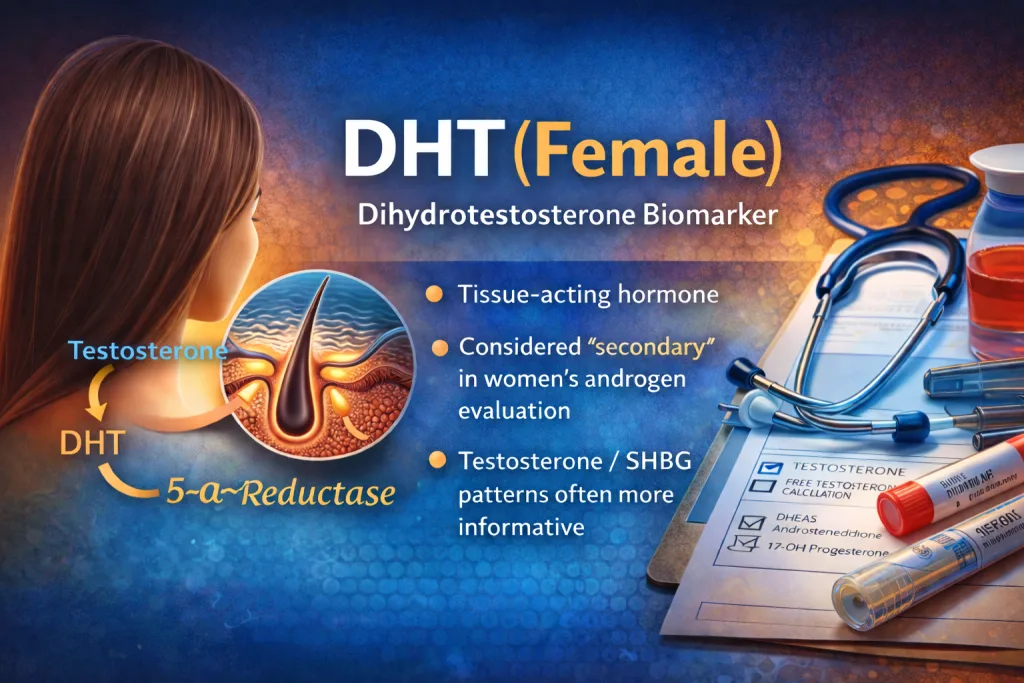
DHT (Female): Dihydrotestosterone Biomarker

Understand tissue-level androgen activity, hair/skin signaling, and why DHT is not a first-line lab for hyperandrogenism workups.

Authored by Chris McDermott, APRN — Practicing with autonomous authority in Florida

Dihydrotestosterone (DHT) is a highly potent androgen formed primarily through local (tissue) conversion of testosterone via 5-α-reductase—especially in skin and hair follicles. In women, circulating DHT can be measured, but clinical interpretation requires context because androgen effects are often driven by tissue-level DHT activity rather than serum levels, and recent guidance does not recommend DHT as a routine biochemical test for suspected androgen excess. Learn more about our lab-guided approach within a functional medicine framework.

DHT Female Biomarker Testing - Intercoastal Health FL

Understanding DHT Biomarker in Women

🧬 What is DHT (Female)?

DHT is an androgen produced from testosterone by 5-α-reductase. Compared with testosterone, DHT binds the androgen receptor more strongly and is a key mediator of androgen signaling in skin/hair and other androgen-sensitive tissues.

Key Concepts to Understand DHT in Females

DHT is mostly “local,” not just blood-level

Serum DHT may not reflect what’s happening inside the hair follicle or skin because conversion and action occur within tissues.

Clinical utility is limited for androgen-excess screening

Current guidance indicates DHT is not recommended for routine measurement in the biochemical work-up of androgen excess in women (testosterone-based evaluation is typically more informative).

Menstrual cycle stability

In healthy premenopausal women, DHT does not significantly change across the menstrual cycle, unlike testosterone (which varies more).

📊 Standard Reference Ranges for DHT (Female) (Example: LC-MS/MS, reporting in pg/mL)

Example lab cutoffs (adult females, LC-MS/MS):

  • Age 20–55: ≤300 pg/mL

  • Age >55: ≤128 pg/mL

Ready to Take the Next Step?

Concerned about acne, unwanted hair growth, or hair thinning? Schedule a functional medicine evaluation to review androgen drivers (testosterone/SHBG patterns, insulin signaling, and inflammatory contributors) and build a targeted plan.

Individualized care • Medically supervised • Lab-guided treatment

⚠️ Abnormal DHT Female Levels: Clinical Implications

Low DHT (Female)

  • Very low DHT may be seen with strong suppression of androgen production/action, but clinical significance is often unclear without symptoms and broader androgen testing.

High DHT (Female)

  • Elevated DHT can align with androgen-mediated symptoms (acne, hirsutism, androgenic-pattern hair changes), but serum DHT alone is not the preferred diagnostic anchor.

🧪 Interfering Factors in DHT Testing

Physiologic/Clinical Factors
or Assay Interference

  • PCOS physiology & insulin resistance may increase overall androgen signaling and 5-α-reductase activity patterns (often better captured with testosterone/other androgens plus clinical features than DHT alone).

  • Body composition changes, rapid symptom onset, or postmenopausal onset of androgenic signs should prompt a broader evaluation (not DHT-only).

Medications Affecting
DHT Levels

  • Increase androgen signaling/DHT: exogenous androgens (testosterone therapy, anabolic-androgenic exposure).

  • Decrease DHT action/formation: 5-α-reductase inhibitors (finasteride/dutasteride) and anti-androgens used in hyperandrogenic symptom management.

🔍 Related & Complementary Testing

DHT Female assessment is most informative when evaluated alongside:

One test panel anchor:

  • Total testosterone (preferably high-quality assay) + SHBG → Free Androgen Index (FAI)

    This is commonly more clinically actionable for suspected hyperandrogenism than DHT alone.

🩺 When to Test DHT Female Lab

Consider DHT as a secondary biomarker when:

  • You’re monitoring response to therapy affecting 5-α-reductase activity, or

  • The clinical picture suggests unusual androgen metabolism and you’re already doing a structured androgen work-up.

For most women with acne/hirsutism concerns, start with testosterone-based evaluation and clinical scoring rather than leading with DHT.

🧠 Clinical Interpretation Considerations

Important Interpretation Considerations

  • Do not over-interpret “normal DHT.” Tissue conversion can be high even when serum DHT is not striking.

  • Symptom pattern matters: acne/hirsutism + menstrual irregularity + metabolic features → think structured PCOS/hyperandrogenism evaluation.

  • Red flags (rapid virilization, severe biochemical abnormalities, postmenopausal onset) warrant expedited endocrine evaluation.

✅ Clinical Summary

DHT (Female) is a potent androgen but is primarily a tissue-acting hormone. While serum DHT can be measured, current evidence-based guidance indicates it is not recommended as a routine test for the biochemical evaluation of androgen excess in women. In functional medicine practice, DHT is best interpreted alongside testosterone/SHBG (FAI), symptom patterns (skin/hair changes, menstrual regularity), and cardiometabolic context.

📚 Further Reading

3.Evaluation and Treatment of Hirsutism in Premenopausal Women: An Endocrine Society Clinical Practice Guideline.The Journal of Clinical Endocrinology and Metabolism. 2018. Martin KA, Anderson RR, Chang RJ, et al.Guideline
4.Androgen Therapy in Women: A Reappraisal: An Endocrine Society Clinical Practice Guideline.The Journal of Clinical Endocrinology and Metabolism. 2014. Wierman ME, Arlt W, Basson R, et al.Guideline
5. Causes, Patterns, and Severity of Androgen Excess in 1205 Consecutively Recruited Women. The Journal of Clinical Endocrinology and Metabolism. 2018. Elhassan YS, Idkowiak J, Smith K, et al.

Ready to Take the Next Step?

Get a clinician-guided interpretation of your hormone biomarkers with personalized nutrition, lifestyle, and evidence-guided therapeutics—built around your symptoms, cycle stage, and metabolic risk profile through our functional medicine evaluation.

Personalized care • Clinician-directed • Data-driven treatment

Intercoastal Health

Business Hours
Monday: 9AM – 6PM
Tuesday: 9AM – 6PM
Wednesday: 9AM – 6PM
Thursday: 9AM – 6PM
Friday: 9AM – 6PM
Saturday: Closed
Sunday: Closed

Request an Appointment

Please do not include sensitive medical information.
Patient Consent & Acknowledgment